How Beverage Sales Teams Can Leverage Location Intelligence to Win the UK HORECA Market
The UK on-premise market in 2026: 290,000+ open outlets, 87% independent, about 30% on a delivery app, and where managed pubs change the sales job.
Key findings
- The UK has 290,000+ open on-premise outlets across restaurants, bars and pubs, cafes, quick service and hotels, including 94,000+ restaurants.
- 87% of UK outlets are not part of a detected chain of 5+ locations trading under one name: most of the market is won outlet by outlet, not at head office.
- About 30% of UK outlets are on a delivery app we track, a useful signal of how a venue trades.
- Of the UK's 28,000+ pubs, 15% are run by an identified managed group; in London, with 2,700+ pubs, it is 30%.
- 15,000+ UK pubs have at least one menu read, so a rep can see what is already on the bar before the visit.
Data as of October 2026.
For beverage suppliers looking to enter or grow in the UK's hospitality sector, finding the right venues, whether restaurants, cafes, hotels, bars or pubs, is most of the job. In a market this large and this fragmented, the question is not whether the outlets exist. It is which ones to visit first, and who you are really selling to when you walk in.
DashLeads gives sales teams an outlet-level view of the UK on-premise market: where every venue is, how it trades and who runs it. Here is what that view shows in 2026, and how teams use it.
The UK on-premise universe in 2026
The UK has 290,000+ open on-premise outlets across five channels: restaurants, bars and pubs, cafes, quick service and hotels. Venues that are permanently or temporarily closed are left out, so every outlet in the count is one a rep could visit today.
Restaurants alone account for 94,000+ of them.
For a beverage brand, the channel split is the first filter. A brand aimed at nightlife looks to bars and pubs, a premium label to hotels and upscale restaurants, a soft drink or energy drink to quick service and takeaways. Location intelligence lets you start from the channel that fits your product and ignore the rest.
Most of the market is independent
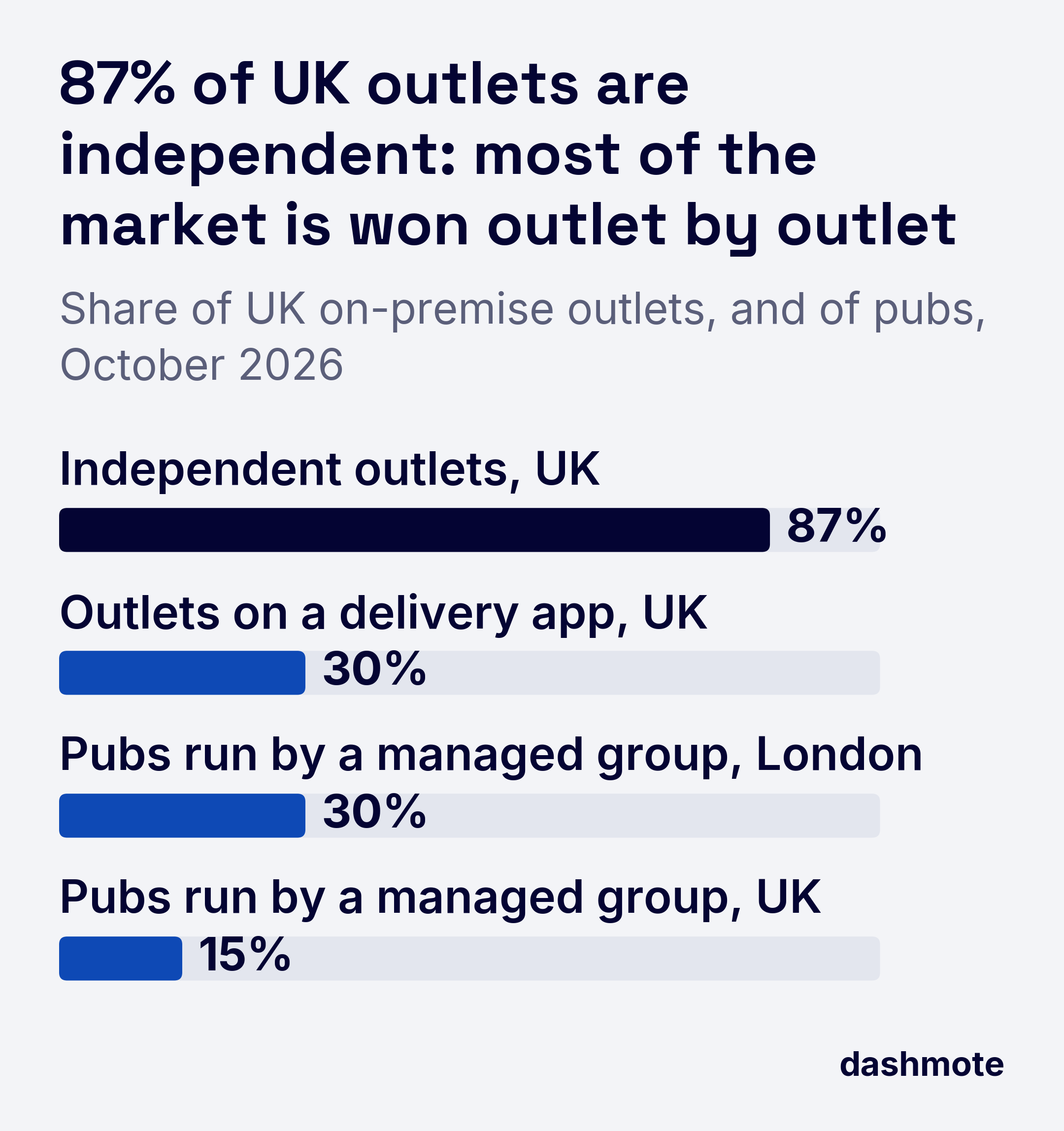
87% of UK outlets are independent, meaning they are not part of a detected chain of 5+ locations trading under one name.
That number shapes the whole sales approach. Chains can be won in one meeting at head office. Independents cannot: each one decides for itself, and most of them never appear in a distributor's key-account list. Reaching them means knowing where they are, street by street, and which of them fit your brand.
It also means the market is wider than any CRM. The gap between the outlets that fit your brand and the outlets you already serve is your white space, and in a market this independent it is usually larger than teams expect.
Delivery as a trading signal
About 30% of UK outlets are on a delivery app we track, either matched to a storefront on the app or with a delivery app linked on their map listing.
Delivery activity tells a rep something about how a venue trades: it serves guests at home as well as at the table, it lists its menu online, and its drinks range is visible before the visit. For brands that sell through both channels, it is also a second route into the same outlet.
Pubs: who really runs them
Pubs are where the UK on-trade is hardest to read from the street. The UK has 28,000+ pubs (venues listed as a pub, Irish pub or brewpub), and 15% of them are run by an identified managed group: a pub company, brewery, bar, leisure or hotel group running the site under management.
In London the picture is different. Of 2,700+ pubs in Greater London, 30% are run by an identified managed group, twice the national share. And 16% of London pubs are on Deliveroo, Just Eat or Uber Eats.
Why it matters: selling to an independent pub and selling to a managed pub are two different jobs. An independent owner can often change the range on the spot. A managed pub's manager usually cannot, and the listing conversation starts at the group. The pub sign rarely tells you which job you are doing. Our deep dive on London's managed pubs shows how many pubs that look like locals are run by a bigger group.
What is already on the bar
15,000+ UK pubs have at least one menu read in DashLeads. That shows a rep which beer, spirit and soft-drink brands are already listed before they walk in, so the visit starts from what the venue actually serves rather than a guess.
Turning the map into a plan
The numbers above describe the market. Sales teams use them to decide where field time goes:
- Cut territories on fit, not postcodes. Sales territory planning puts every scored outlet and current account on one map, so each rep gets a fair share of the outlets that matter.
- Rank the outlets. Foodservice lead scoring scores each outlet against the ideal account you describe in plain words, so reps see the best fits first.
- Find the clusters. The outlet hotspot map shows where high-fit outlets sit close together, so one parking spot can fill a morning of visits.
- Separate independents from managed sites. Independents get the visit; managed pubs get the group conversation, with the right person.
Definitions
- Open on-premise outlets: restaurants, bars and pubs, cafes, quick service and hotels, with permanently and temporarily closed venues excluded.
- Independent: not part of a detected chain of 5+ locations trading under one name. Smaller groups, and groups whose venues trade under different names, count as independent.
- On a delivery app: matched to a storefront on a delivery app we track, or with a delivery app linked on the outlet's map listing.
- Pubs: venues listed as a pub, Irish pub or brewpub. Pubs listed as bars are not in this count.
- Run by an identified managed group: a high-confidence record names a managed operator for the site. This describes who operates the pub, not its supply terms.
If your team sells into the UK on-trade, book a demo or get in touch to see the outlets, operators and menus in your own territory.
Related: UK pub data, Who really runs your local? London's managed pubs and outlet hotspots: where to prospect next.