
Foodservice lead scoring: which outlets to visit first
Foodservice lead scoring ranks the bars, restaurants, cafes and hotels in a territory by how likely each is to list your product, and Dashmote has scored 20M+ venues and can score any of the 20M+ it maps in 60+ countries. Describe your ideal account in plain words and AI reads each outlet's menu, photos, delivery listings and reviews, so you know which doors to knock on first.

The trusted intelligence layer for teams selling to Hospitality & Retail








What a lead score answers: which bars should I visit this week?
A field rep has a fixed number of visits in a week. Every visit spent on a venue that will never list you is a visit taken away from one that would. A lead score turns that judgement into a ranked list, so the first visits go to the likeliest yes.
In DashLeads each outlet gets a score from 0 to 100. The score combines two questions:
- Fit: does this venue look like the accounts you win? Type, cuisine, price level and what is already on the menu.
- Potential: is it worth the visit? Size, review volume, how active it is online, and whether it is growing.
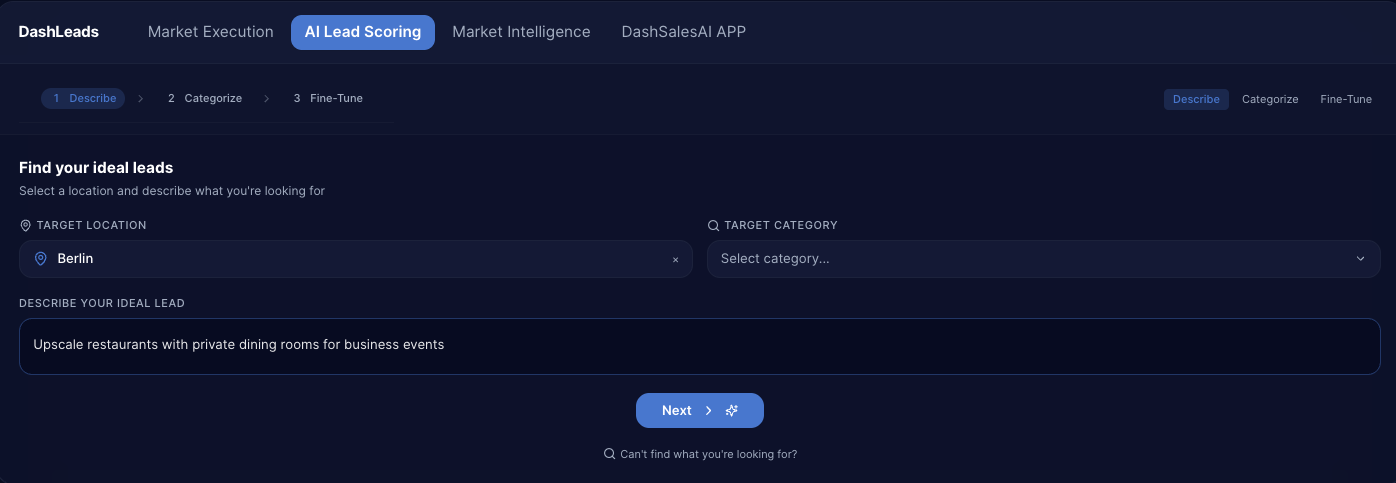
You set the target in your own words, for example "cocktail bars with a late licence and a premium spirits list" or "independent Italian restaurants with a wine list". The AI applies that description to all the outlets it maps in your territory, not only the ones already in your CRM. The research is done before the rep leaves the office, so the week goes to owners, not to spreadsheets.
The signals that predict a listing
No single signal decides a listing. The ones below, read together, separate the venues worth a visit from the rest. Each is visible from public sources before anyone sets off.
- What is on the menu. The brands named on the drinks list or menu card, whether your category is there at all, and whether a competitor already holds the spot. A venue with a cocktail list and no premium gin is a different pitch from one that pours a rival gin.
- Venue profile. Channel, cuisine, venue type, price level and opening hours. These decide whether your product fits the room.
- Who decides. Independent owner or a managed group. In our London study of about 250 managed pubs from eight groups, many traded under their own names with no visible link to the group, and the range is usually decided centrally, not at the bar.
- Activity. Review volume and recent reviews, social posts. Active venues sell more volume and change their range more often.
- Delivery and booking. Listings on delivery platforms and booking links, which signal how the venue operates and how much it sells beyond its seats.
Worked example: a score card for one venue
A premium spirits rep targets independent cocktail bars. Here is how one venue scores against that description.
| Signal | What the data shows for this bar | Fit level | Effect |
|---|---|---|---|
| Venue type | Cocktail bar, late opening | High | Strong fit |
| Menu | Signature cocktails, gin listed by name: a competitor's brand | High | Category present, displacement pitch |
| Price level | Upper mid | Medium | Fits premium range |
| Operator | Independent, owner-run | High | Decision made on site |
| Activity | Weekly events, steady flow of recent reviews | Medium | High throughput |
| Delivery | Not listed | Low | No effect for this brand |
| Result | Score 86 of 100: visit this week |
A second bar down the road has a similar menu but belongs to a managed group. It scores lower for a rep visit and goes on the list for the key account manager who talks to the group.
Lead scoring best practices your reps will trust
- Start from your best accounts. Describe the venues that already sell your product well, then let the AI find the ones that look like them.
- Check the top of the list by eye. A rep who knows the area will spot a wrong venue type fast. Fix the description, not the list.
- Match your CRM. Upload your account list so current customers are marked and the score points at accounts you do not serve yet.
- Turn scores into tiers. A, B and C bands with a visit rule for each are easier to plan with than a number.
- Review after wins and losses. When a high score does not convert, ask why and fine-tune the profile. A score nobody questions is a score nobody uses.
Lead scoring in your CRM versus outlet scoring
CRM lead scoring rates people who have already shown interest: an email opened, a form filled, a webinar attended. Bar and restaurant owners rarely fill in forms, so most of your market never enters that funnel.
| CRM lead scoring | Outlet scoring in DashLeads | |
|---|---|---|
| Scores | Contacts already in your system | All mapped outlets in the territory |
| Based on | Clicks, opens, form fills | Menu, venue, activity and delivery signals |
| Finds new accounts | Only after they contact you | Before you contact them |
| Best use | Inbound follow-up | Choosing which doors to visit |
The two work together: scored outlets go into your CRM by CSV or API export, and your CRM history sharpens the profile.
Frequently asked questions
How is a lead score calculated?
A lead score is calculated by comparing each outlet's signals with the profile of the accounts you want, as you describe it for your product. DashLeads reads menu, venue, activity, delivery and operator signals for each outlet and returns a score from 0 to 100.
Can you give me an example of lead scoring?
Yes: an independent cocktail bar that lists a competitor's gin, opens late and runs weekly events scores high for a premium spirits rep, while a similar bar run by a managed group scores lower for a rep visit because the range is decided centrally. The worked example on this page shows the full score card.
What are some best practices for lead scoring?
The best practices are to start from your best existing accounts, check the top of the list with reps who know the area, match your CRM so current customers are marked, turn scores into A, B and C tiers, and fine-tune the profile after every run of wins and losses.
What signals predict that an outlet will list my product?
The strongest signals are what is already on the menu (your category, a competitor), the venue profile (type, cuisine, price level), who decides (independent owner or managed group) and activity (reviews, social posts, delivery listings). Read together they separate likely accounts from the rest.
How is this different from lead scoring in my CRM?
CRM lead scoring rates contacts who already engaged with you, while outlet scoring rates the venues in the territory, including the ones that have never heard of you. Most bar and restaurant owners never fill in a form, so outlet scoring covers the part of the market a CRM cannot see.
How often are scores updated?
Outlet records are updated monthly and delivery data refreshes monthly, and scores are recomputed on the latest data each time your model runs: venues that stop trading leave the list, new openings join it, and menu changes move a venue up or down the list.
Can I try it on my own territory?
Yes: enter your company website, describe your ideal customer and pick a test city, and you get scored outlets to evaluate before you commit.
Related reading
For sales leaders: the business case
If you run the team rather than a single territory, a shared outlet score changes three things you report on.
- Visits that convert. Reps start the week from a ranked list, so visits per new listing becomes a number you can track and improve. Delivery listings sit on the same outlet record (see food delivery insights).
- Targets set on the real market. CRM matching shows how many fitting outlets each territory still has untouched, so quotas follow opportunity, not history.
- One standard across the team. Every rep works from the same model, and you pay per lead pack or per territory with unlimited seats. See pricing.