Former Quandoo restaurants across Europe and Asia-Pacific: where they already book
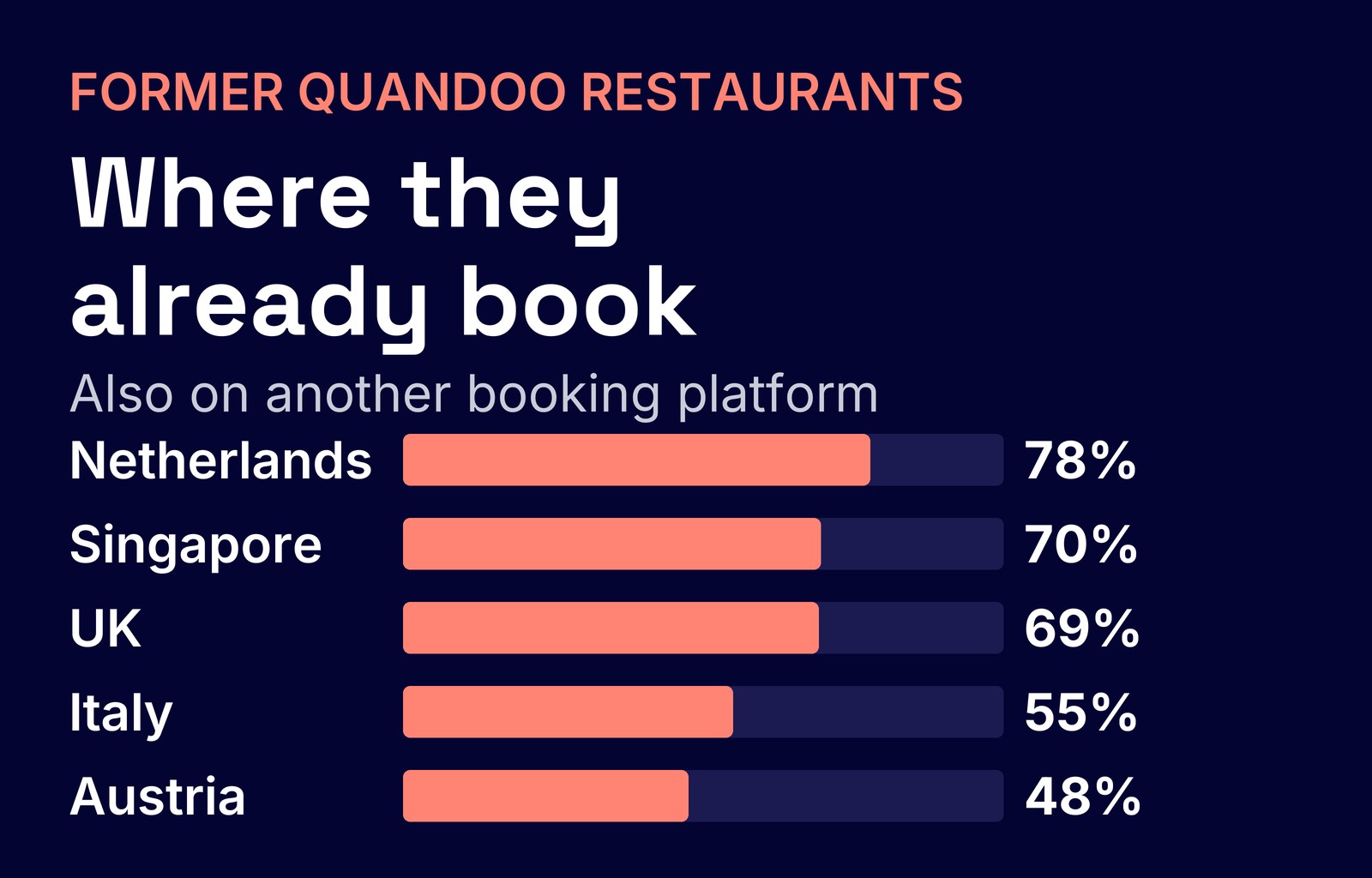
Quandoo stopped accepting new bookings after 30 September 2026. In the Netherlands, Singapore and the UK most of its former restaurants are already on another booking platform; in Finland, Turkey and New Zealand most have none we can find.
Key findings
- Quandoo stopped accepting new bookings after 30 September 2026 and goes offline by 31 December. Italy held 34% of its restaurants, Germany 19%, Australia and the UK 13% each.
- In the Netherlands 78% of former Quandoo restaurants are also on another booking platform, in Singapore 70% and in the UK 69%. In Italy it is 55%.
- In Turkey 89%, Finland 85% and New Zealand 83% have no other booking platform we can find; in Germany 64%.
- TheFork already lists the most of them in Europe: 58% in the Netherlands, 56% in the UK (a large part of it one pub group) and 51% in Italy. Chope leads in Singapore with 52%, OpenTable in Australia with 30%.
Data as of October 2026.
Quandoo, the Berlin-based restaurant reservation platform owned by Japan's Recruit Holdings since 2015, stopped accepting new bookings after 30 September 2026 and is winding down; its site goes offline by 31 December. The wind-down was announced in late March 2026, and the site goes offline by 31 December 2026.
That leaves restaurants across Europe and Asia-Pacific that used Quandoo to take bookings. Here is which other booking platforms they are also on today. It shows where they can already be booked, not what happened after the closure: many of these restaurants used several platforms side by side long before Quandoo closed.
How big Quandoo was, country by country
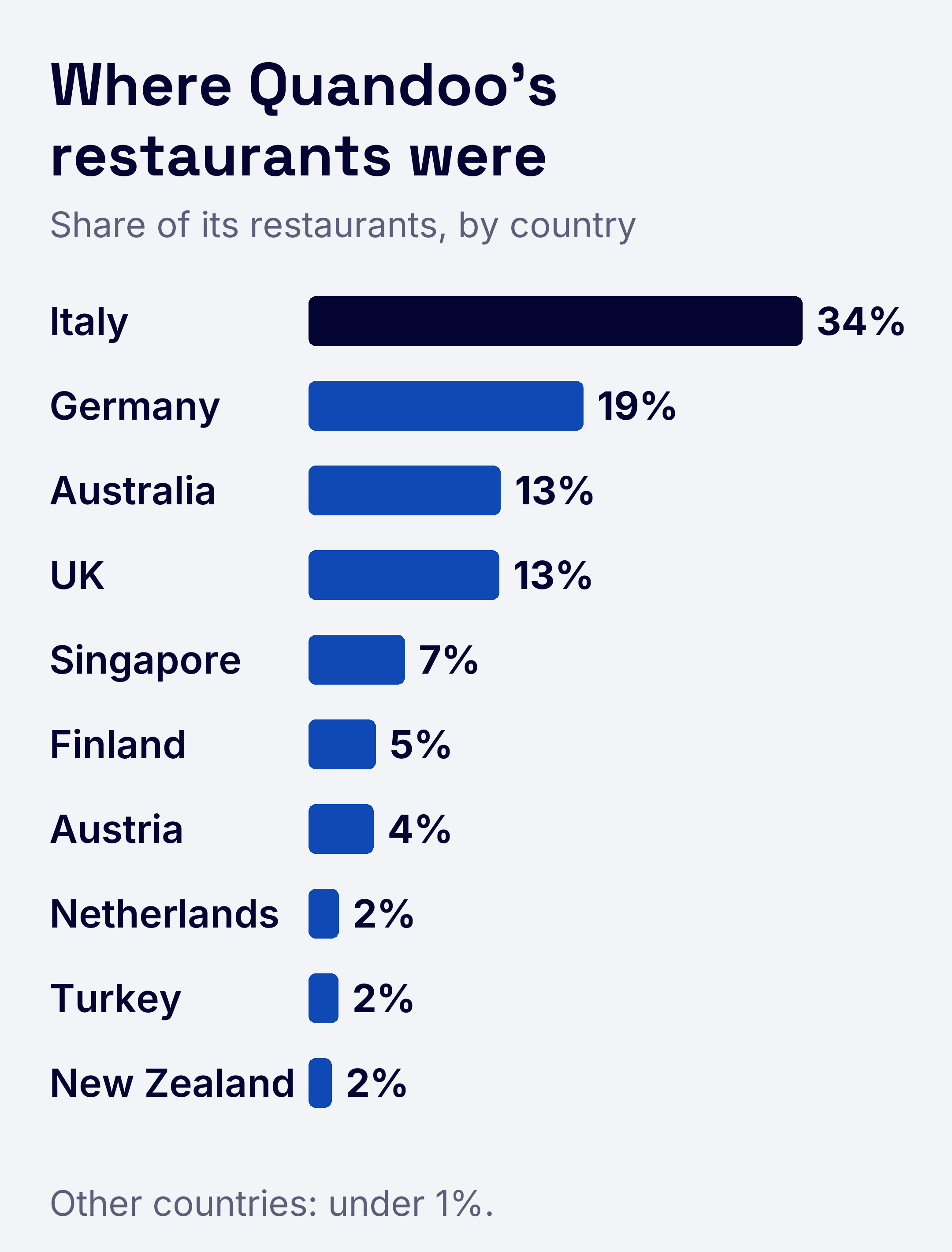
Share of the restaurants Quandoo still listed, by country, October 2026.
Italy was Quandoo's biggest market by far, with 34% of its restaurants, then Germany with 19%. Australia and the UK each held 13%, Singapore 7%. Finland, Austria, the Netherlands, Turkey and New Zealand were smaller, and Switzerland and Hong Kong too small to show.
Where they already book
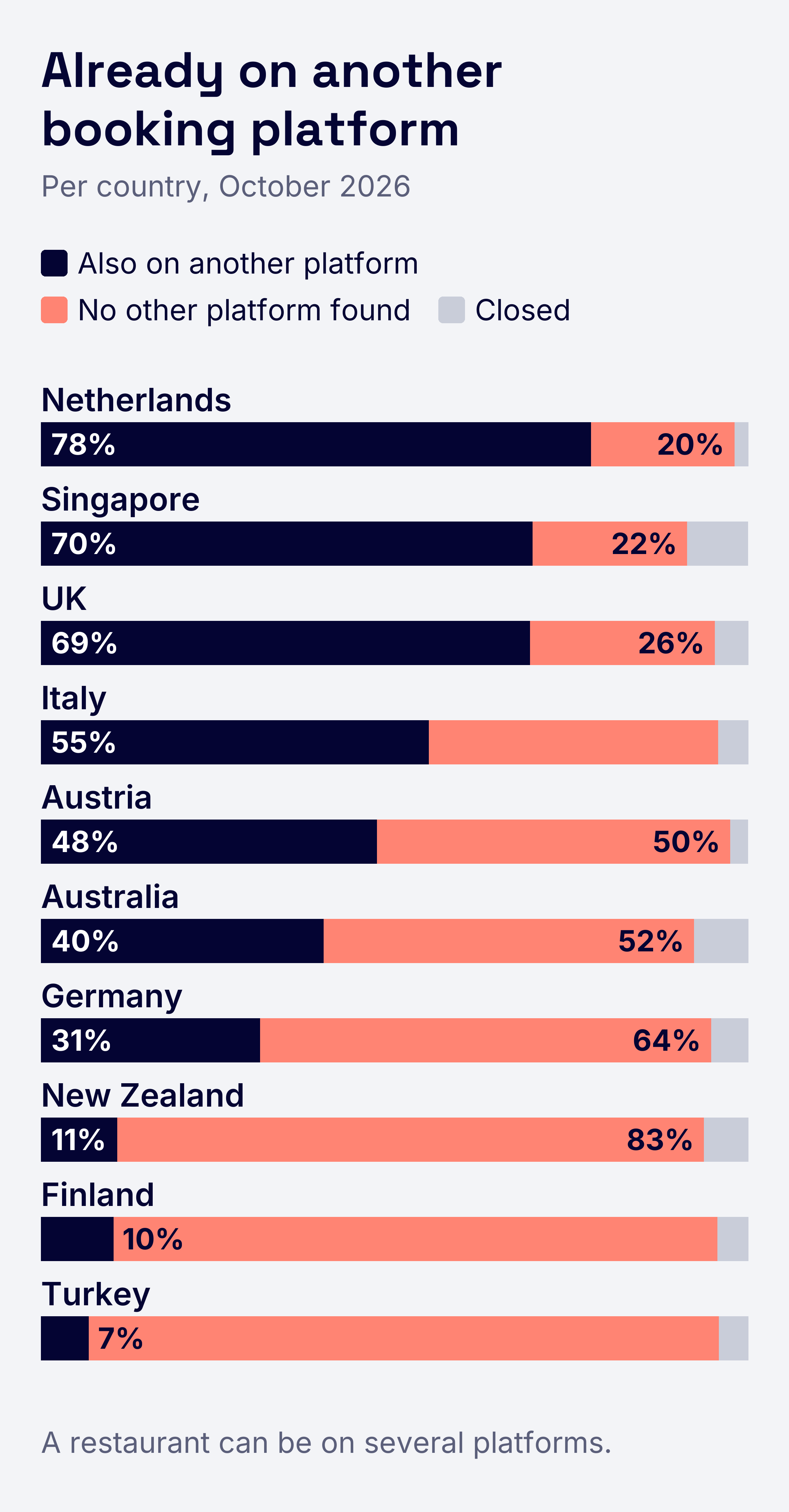
Share of former Quandoo restaurants in each country, October 2026. A restaurant can be on several platforms.
The countries split in two. In the Netherlands, 78% of former Quandoo restaurants are also on another booking platform, in Singapore 70% and in the UK 69%. In Italy it is 55%.
At the other end, most have nothing else we can find. In Turkey 89% of former Quandoo restaurants have no other booking platform we can find, in Finland 85% and in New Zealand 83%. Germany (64%), Australia (52%) and Austria (50%) sit in between.
Which platforms already hold them
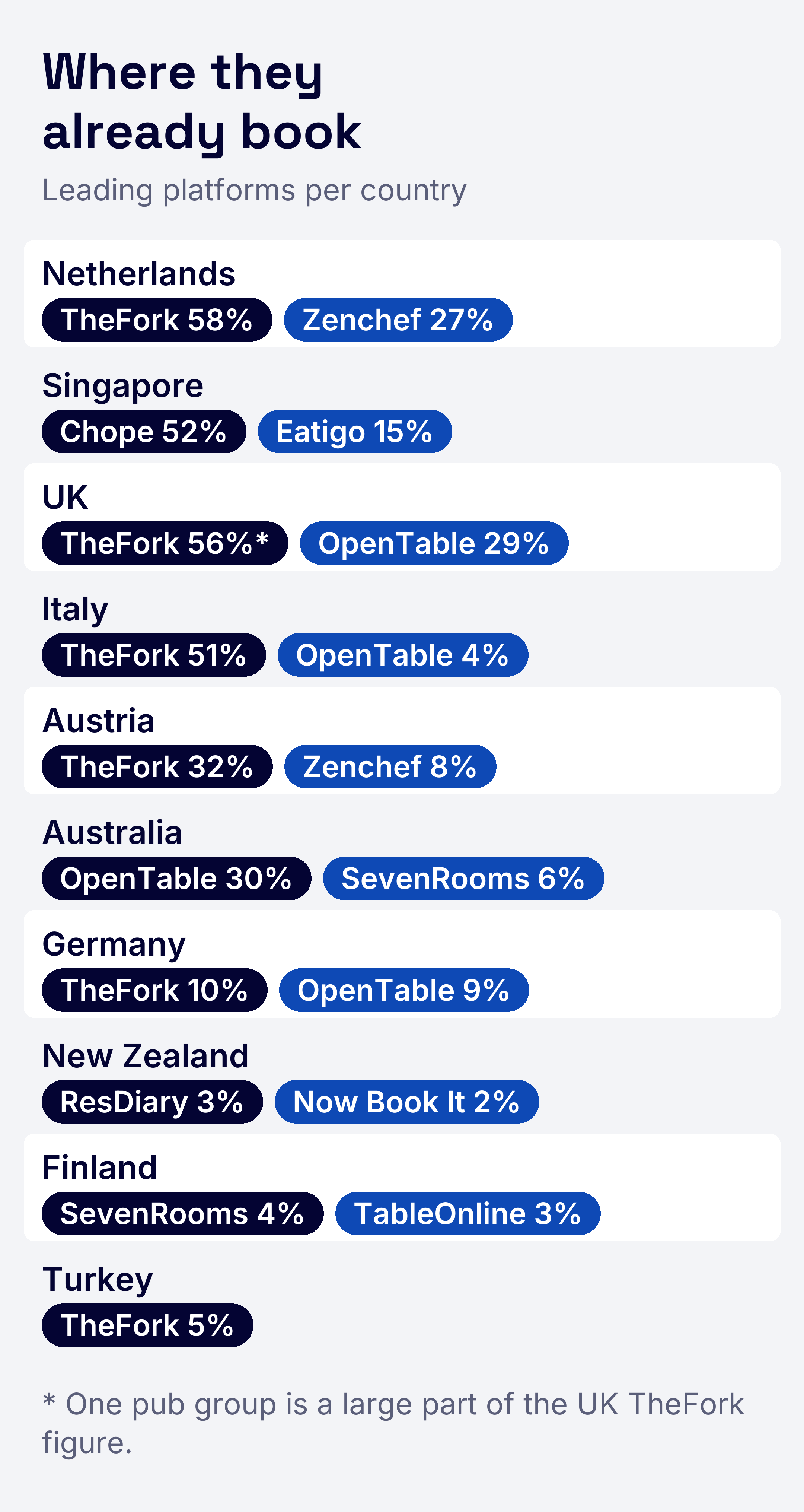
Share of each country's former Quandoo restaurants on each platform, October 2026. Shares do not add up: a restaurant can be on several.
TheFork already lists the most former Quandoo restaurants in Europe. It holds 58% of them in the Netherlands, 56% in the UK, 51% in Italy and 32% in Austria. In the UK, one pub group is a large part of that figure.
Elsewhere a local platform leads. In Singapore, 52% are on Chope. In Australia, 30% are on OpenTable and 6% on SevenRooms. Germany has no clear leader: TheFork 10%, OpenTable 9% and Zenchef 5%.
What comes next
We expect the restaurants with no other booking platform to be the ones to watch, and the opportunity for anyone selling bookings, tables or guest software:
- Germany, Australia and Austria have 64%, 52% and 50% of their former Quandoo restaurants on no other platform we can find, and Germany and Australia were among Quandoo's biggest markets.
- Finland, Turkey and New Zealand are smaller but almost untouched: 85%, 89% and 83% have nothing else.
- The Netherlands, Singapore and the UK are already mostly booked elsewhere, so the question there is which platform a restaurant keeps, not whether it books online.
With the Quandoo site offline by 31 December 2026, restaurants that still show it as their only booking option will need another one, or take bookings by phone.
DashLeads covers restaurants, cafes and bars in 60+ countries and 100+ platforms, with the booking, POS and loyalty systems each one runs where we can see them. If your team sells to restaurants, book a demo.
Public listings and booking-platform records, October 2026. Shares are of each country's former Quandoo restaurants; a restaurant can be on several platforms. For who leads restaurant booking in six European cities, see Quandoo stopped accepting new bookings: where its restaurants already book, the restaurant reservation data and the rest of restaurant tech data.