
What does POS mean?
POS stands for point of sale. In food and drink it most often means the POS system (EPOS) that records a sale, or the outlet where the sale happens; marketing teams also use it for the branded kit in the venue, which has its own entry: POS material. Always ask which one a report counts, because each gives a different number for the same street.
The trusted intelligence layer for teams selling to Hospitality & Retail







Three meanings of POS
| Meaning | Also called | Who says it | What gets counted |
|---|---|---|---|
| The system | EPOS, ePOS, register, POS system, checkout | Restaurant and bar operators, POS-system vendors, finance teams | Transactions, terminals, sites running a system |
| The outlet | Point of sale, POC (point of consumption), PDV (ponto de venda, punto de venta), outlet, account | Field sales, trade marketing, brewers, distributors | Outlets that sell or serve the product |
| The materials | POS material, POSM, POP (point of purchase), PLV in France | Trade marketing, merchandisers, agencies | Items placed in outlets, and whether they are up |
So "we have 400 POS in this city" can mean 400 POS systems, 400 outlets or 400 pieces of kit. In a meeting with a brand, a vendor and a distributor, it can mean all three.
Who means what by POS by role
| Role | What they usually mean | What they count |
|---|---|---|
| eCommerce manager | The restaurant's POS that delivery app orders are pushed into | Storefronts with a working order integration |
| Field sales rep | The outlet, or the branded kit in it ("did the POS go up?") | Outlets visited, kit installed |
| Category manager | Point of sale data: sales scanned at checkout | Units and value sold |
| Distributor | The outlets it delivers to, often "points of sale" in contracts | Delivery points |
| POS-system vendor | The hardware and software | Sites and terminals on its system |
| Market researcher | EPOS data (checkout-level sales) or the outlet in a panel | Transactions, or outlets |
Who means what by POS by region
| Region | The system | The outlet | The materials |
|---|---|---|---|
| UK and Ireland | EPOS | Outlet, account, site | POS, POS kit |
| US and Canada | Register, POS system | Account, door, location | POP, POS displays |
| Continental Europe | Kassa (NL), Kasse (DE), caisse (FR) | Outlet, point de vente (FR) | POS material, PLV (FR) |
| Latin America | POS, caja | PDV, POC | Material POP |
| Asia Pacific, Middle East | POS | Outlet, store | POSM |
EPOS (electronic point of sale) is a UK word for the same thing the US calls a POS system; there is no technical difference today. See the Wikipedia entry on EPOS for the history.
Common confusions
- "POS data" from a POS vendor is a list of transactions. From a brand team it is often a list of outlets. Ask for a sample row before you compare two files.
- POS vs POP. In retail marketing, point of purchase is anywhere in the store where the shopper decides, and point of sale is the checkout. In bars and restaurants the two are used as one.
- POS vs POC. Brewers and many beverage companies say point of consumption for on-premise outlets where the drink is drunk, and keep point of sale for shops where it is bought to take away.
- POS material vs POS system. A "POS project" in trade marketing is about signage and glassware; in operations it is about checkout systems. Same three letters, different budgets.
- POC has three meanings too. Point of consumption to a brewer, proof of concept to a project team, point of contact in an email. A brewer's CRM can key every outlet on a "POC code" while a supplier pitches it a POC.
How Dashmote uses the word
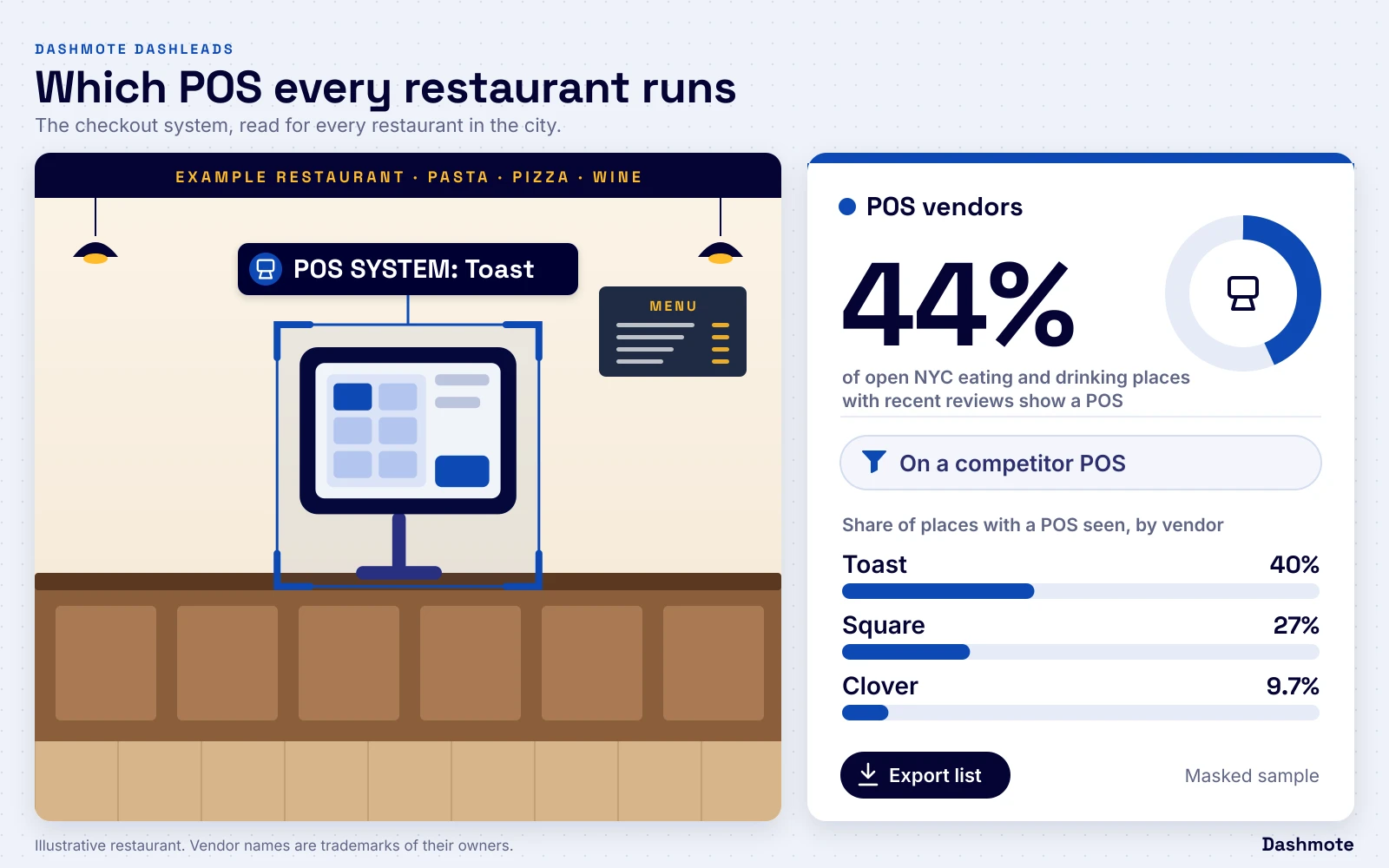
We say venue or outlet for the place, POS system for the checkout system and POS material for branded kit, and never use POS alone. Public profiles show the POS system a venue runs (restaurant POS data), and which branded materials show in venue photos (POS material detection). Both sit on the same venue record across 60+ countries, so "POS" in any of its three meanings can be counted against the same list of outlets.
Worked example illustrative
A brand manager asks: "How many POS do we have in this district?" Three teams answer with made-up but typical figures.
- Field sales counts outlets that stock the brand: 120.
- A POS-system vendor counts sites running its system in the same district: 60, of all outlets, stocking the brand or not.
- Trade marketing counts materials: 300 branded items across 80 outlets.
None of the three is wrong. The useful report names the unit: 120 outlets stock the brand, 80 of them carry branded kit.
Frequently asked questions
What do you mean by point of sale?
Point of sale is the place and moment where a sale is completed: the outlet, and the system at its counter that records the sale. Marketing teams also use the term for the branded materials placed there.
What is POS with an example?
A bar's checkout that prints the bill is a POS system; the bar itself is a point of sale for a beer brand; the branded drip mats on its counter are POS material.
What does POS mean in marketing?
In marketing, POS often stands for the materials placed where the customer chooses, the sense covered in our POS material entry. In sales and operations it means the outlet or the checkout system.
What is a POP in marketing?
POP means point of purchase: marketing placed where the shopper makes the decision. In the US it is the usual word for in-store displays; in Europe the same items are more often called POS material.
What does POS stand for in retail?
Point of sale. In retail and hospitality it names the checkout system (EPOS, the till) and, for field sales, the outlet itself, also called a door, account or POC.