Restaurant Technology Report 2026: no one owns the restaurant software stack yet
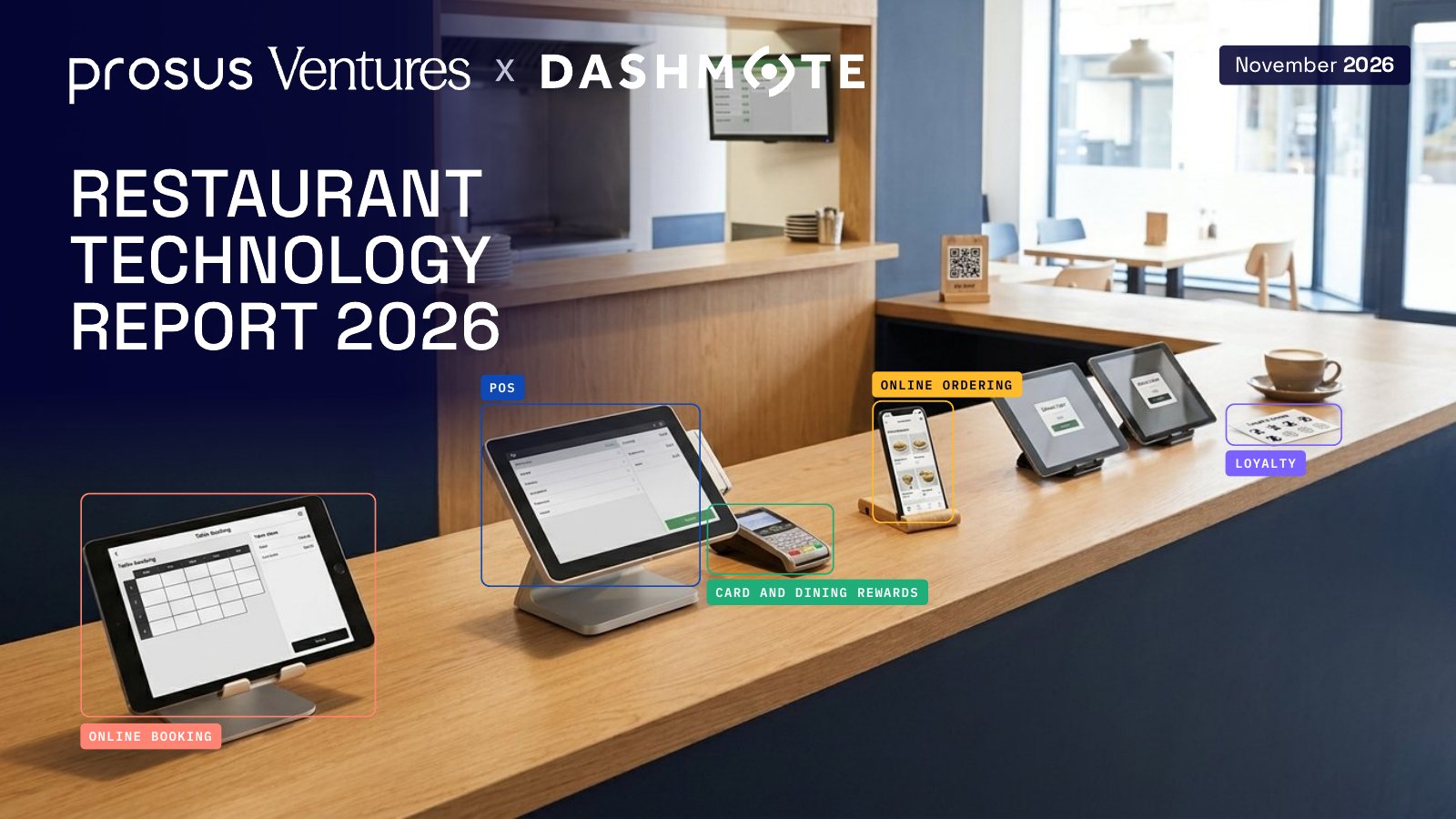
Prosus Ventures and Dashmote have published the Restaurant Technology Report 2026. It maps the POS, online booking, online ordering, loyalty, and card and dining rewards systems restaurants run across the US, Europe, Brazil, India and Asia Pacific, and finds a market that is still local and fragmented.
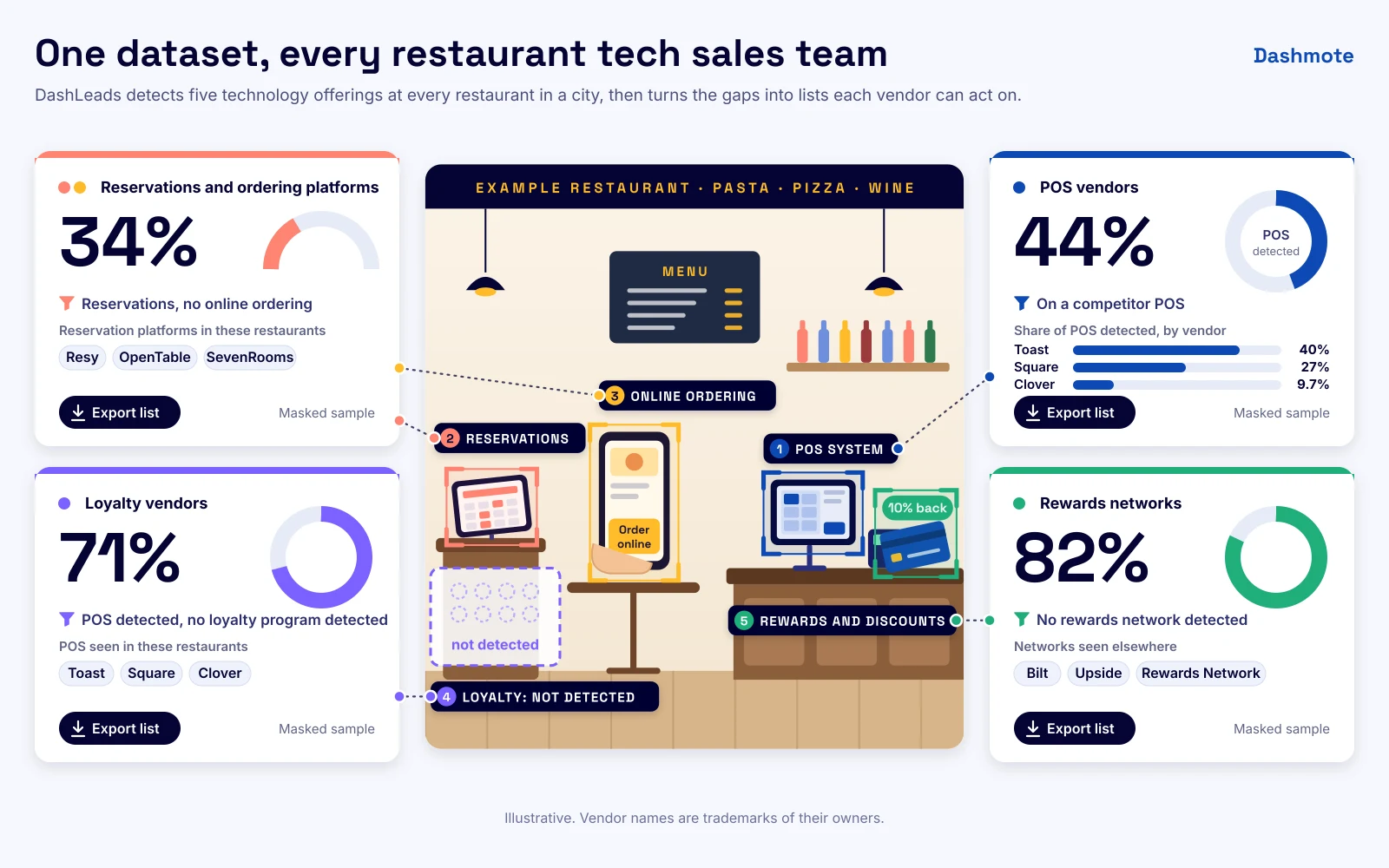
Picture your favourite restaurant. The point of sale runs on one company's software and the card terminal on another's. Bookings come in through a third platform, delivery orders land on a tablet from a fourth, and the loyalty scheme belongs to someone else again. Until now it has been almost impossible to see who supplies what.
So we looked. Together with Prosus Ventures, the early-stage investment arm of Prosus, Dashmote read the public signals of restaurants (their websites, booking and ordering widgets, map listings and delivery storefronts) in New York and other US metro areas, 11 European countries, São Paulo and Rio de Janeiro, Delhi NCR and Mumbai, Singapore, Australia and New Zealand. The result is the Restaurant Technology Report 2026: who leads in five systems (point of sale, online booking, online ordering, loyalty, and card and dining rewards), market by market, and what that means now that AI agents are starting to choose restaurants for diners.
Read the Restaurant Technology Report 2026, or download the full report as a PDF.
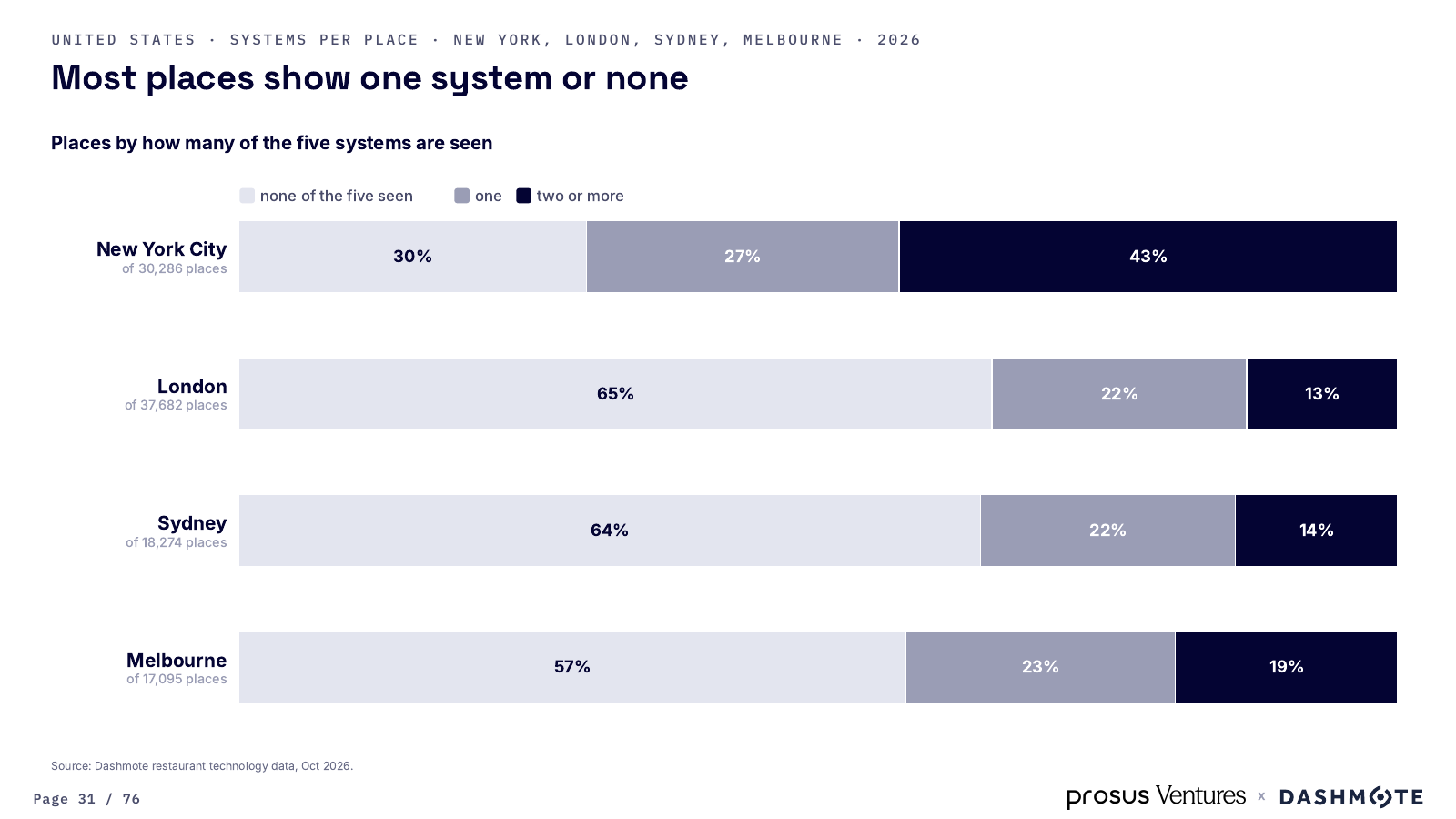
Most restaurants show one system or none
In New York, 57% of eating and drinking places show at most one of the five systems: 30% show none and 27% show one. London, Sydney and Melbourne show the same pattern: 65%, 64% and 57% of places show none of the five. A system that leaves no public trace is not counted, so real use can be higher. Restaurants that do use technology buy it one tool at a time. Of New York Toast places with a second system, four in five use at least one system from another vendor.
Online booking follows price. In six European cities, 85% of restaurants at €60 and up per person are listed on a booking platform, against 2.8% of those under €15. Between chains and independents the gap is far smaller: 29% against 37%.
"Technology is transforming how restaurants interact with their guests, and every restaurant now runs its own set of software, from payments and loyalty to reservations. Yet it is hard to see who uses what, and where. We built Dashmote to bring transparency, venue by venue and city by city, follow the trends locally, regionally and globally, and see where the opportunities are."
Dennis Tan, CEO and co-founder of Dashmote
The leader changes as you travel
Each country, and often each city, has its own booking, ordering and POS leaders. In the US, OpenTable leads online booking nationally, on 52% of restaurants bookable on the six platforms measured, and in New York Toast (40%) and Square (27%) are the POS seen most among places with a POS seen. In Europe no booking platform leads in more than three of the 11 countries: Zenchef leads in the Netherlands, Belgium and Luxembourg, TheFork in Italy and Portugal, and OpenTable in Ireland and the United Kingdom. In Singapore, Chope leads online booking, and OpenTable is on 63% of Melbourne places with online booking seen.
Habit shapes the stack as much as software does. In Brazil, restaurant owners put WhatsApp at 26% of their delivery revenue, second after the delivery apps, by their own estimate (Abrasel survey, March 2025).
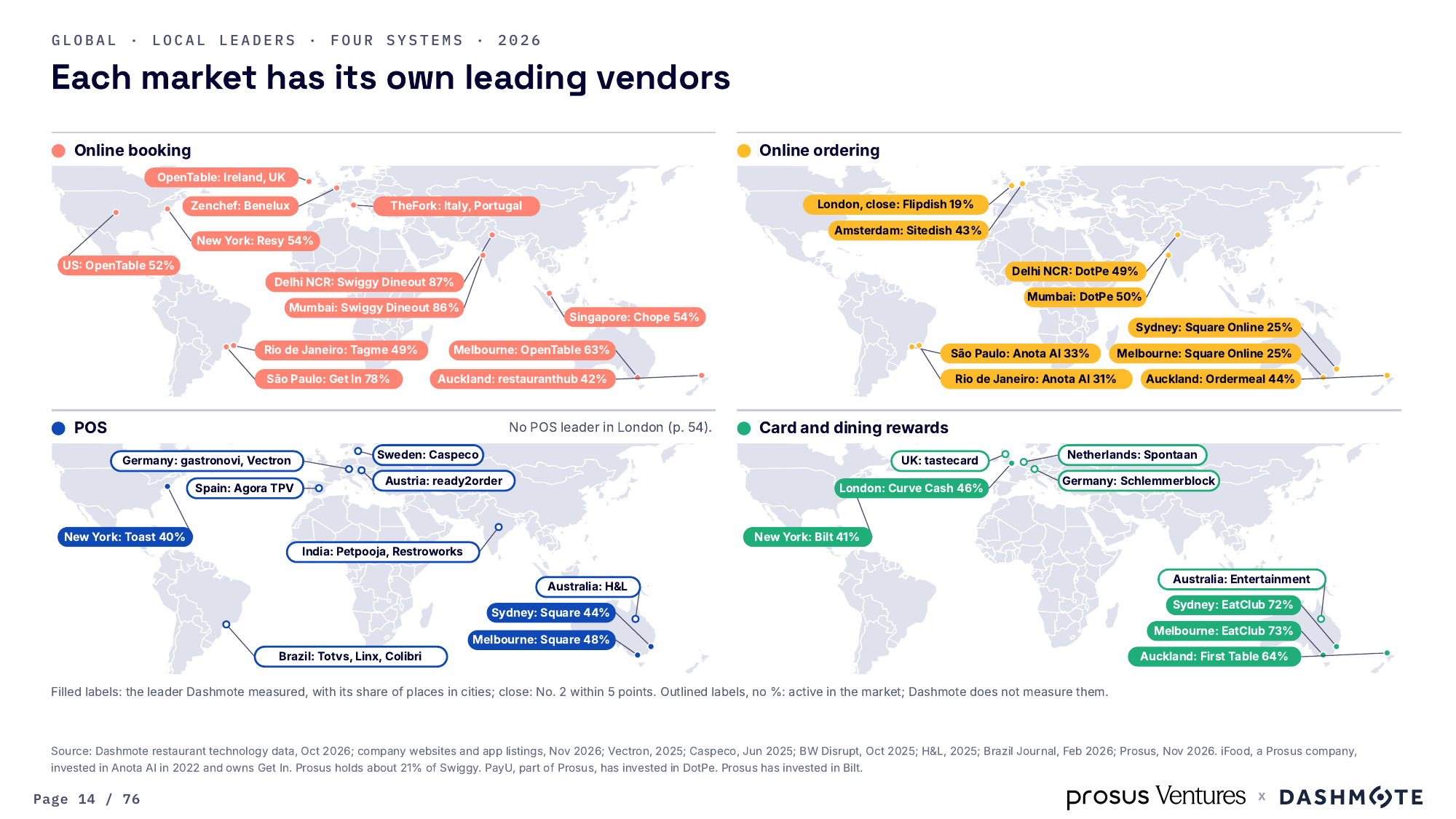
iFood, a Prosus company, invested in Anota AI in 2022 and owns Get In. Prosus holds about 21% of Swiggy. PayU, part of Prosus, has invested in DotPe. Prosus has invested in Bilt.
Money and big buyers are moving in
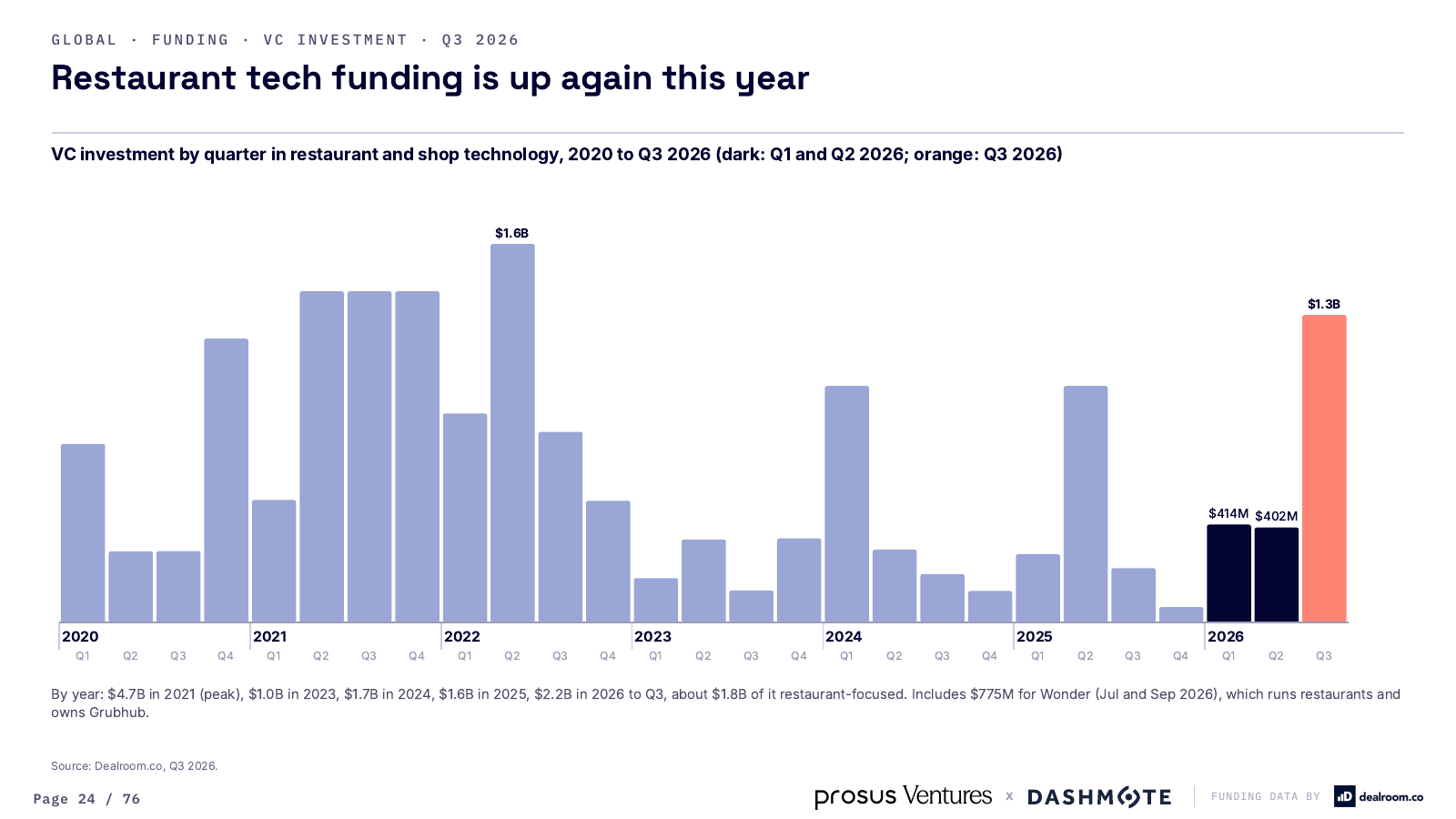
Funding is rising again, led by a handful of large US rounds. Restaurant and shop technology companies raised $2.2B in the first nine months of 2026, against $1.6B in all of 2025, according to Dealroom.co. About $1.8B of the 2026 total went to restaurant-focused segments. Funding peaked at $4.7B in 2021 and fell to $1.0B in 2023. This year's total includes $775M for Wonder, which runs restaurants and owns Grubhub, and online ordering and delivery took 48% of it, because of Wonder and Owner.
Many of the buyers come from outside restaurant software: delivery apps, card issuers and private equity. DoorDash completed its purchase of SevenRooms in June 2025 (about $1.15B), Thoma Bravo took Olo private in September 2025 (about $2.0B), and American Express completed its purchase of TheFork in November 2026.
AI agents need a way in
Diners already ask AI where to eat. 22% of US consumers have used an AI tool to help choose a restaurant (DoorDash survey, May 2026), and 19% of UK consumers use AI tools to plan a visit to a pub, bar or restaurant (Zonal and NIQ survey, October 2026). But most AI use stops at finding a restaurant. Booking through an assistant is live but small: OpenTable's integration with OpenAI seated 190,000 diners in September 2026 (Booking Holdings Q3 call). Ordering is rarer still.
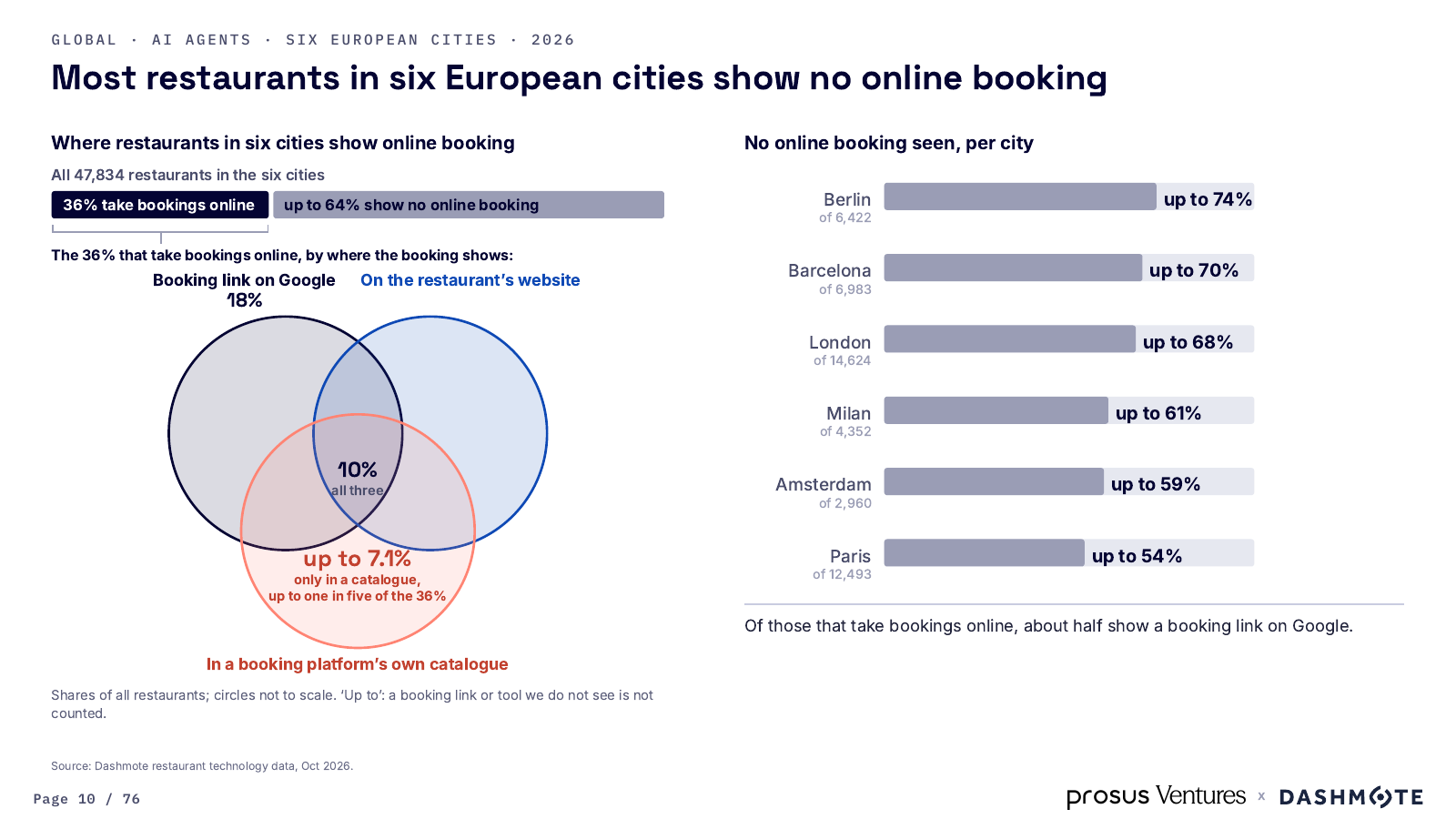
The constraint is access. An agent can only act where a restaurant's systems let it in. In six European cities (Berlin, Barcelona, London, Milan, Amsterdam and Paris), up to 64% of restaurants show no online booking. Of those that do take bookings online, about half show a booking link on Google, and up to one in five are found only in a booking platform's own catalogue, so an agent reaches them only through that platform.
"AI agents may soon choose where people eat. But an agent can only act when a restaurant's systems let it in. This report shows that door is still wide open: restaurants run a patchwork of local tools, and no one has yet become their operating system. That's where we want to invest: in the companies that make every restaurant readable, bookable and orderable by agents."
Thiago Viana da Silva, Global Head of Prosus Ventures
What this means for restaurant technology and F&B companies
No one owns the restaurant software stack yet, so the questions that matter are local. Which restaurants in your territory show which system, which show a rival's, and which show none? The report shows the shares for the markets it covers; Dashmote's data shows it restaurant by restaurant. Dashmote tracks restaurants in 60+ countries and across 100+ platforms. Technology providers use the data to find restaurants on a competitor's system or with no system seen. Food and drink brands and investors use it to size markets, find accounts and track share. AI agents can read it directly through our restaurant data API and MCP server.
Read the full Restaurant Technology Report 2026, explore the restaurant technology data by market, or book a demo to see the data for your market.