
What is route to market?
Route to market (RTM) is the way a product gets from the manufacturer to the outlets and consumers that buy it: which channels it is sold through, who sells to each outlet, who delivers, and who holds the customer relationship; DashLeads tracks 20M+ venues at the end of those routes. The term is used loosely: some teams mean the whole go-to-market plan, others only the distribution model. The opportunity is seeing which outlets each route reaches and which no route reaches yet.
The trusted intelligence layer for teams selling to Hospitality & Retail








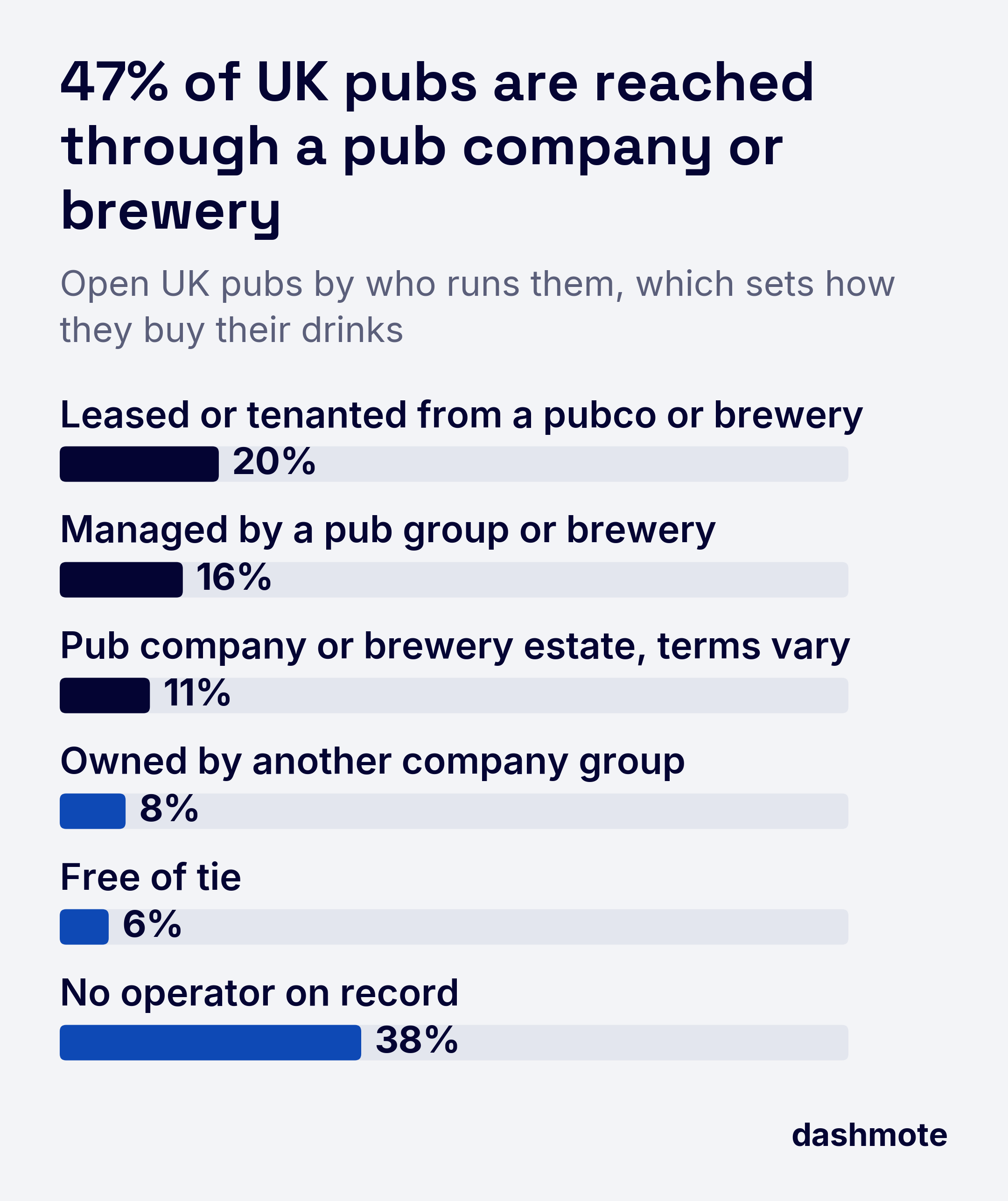
Common route to market models
Most food and drink brands run a mix of these, varying by channel, country and outlet size.
- Direct: the brand's own reps sell and its own fleet or a logistics partner delivers. Full control and customer data, highest cost.
- Distributor: an independent distributor sells and delivers, often exclusively for an area or channel. A common hybrid is direct sell, indirect deliver: the brand's reps win the order, the distributor fulfils it.
- Wholesaler or cash and carry: outlets buy from a wholesaler's range or collect themselves. The brand shapes demand but rarely sees the order.
- Group contract: a chain or buying group buys centrally and has product delivered to its sites or a central depot.
- Online ordering: outlets order on a business ordering platform run by a distributor or the brand.
How to measure it
There is no single formula; a route to market is assessed by where volume flows and what each route costs.
Route share (%) = volume through a route / total volume x 100
Cost to serve per case = selling, delivery and margin costs of the route / cases through the route
Add a coverage view: of the fit outlets in a territory, how many does each route reach, and how many does no route reach at all? That last group is the white space a route change can open. See cost to serve.
Worked example
A soft drink brand sells 100,000 cases a year to the on-trade in one city. Costs are in cost units.
| Route | Accounts | Cases | Route share | Cost to serve per case |
|---|---|---|---|---|
| Direct | 120 | 30,000 | 30% | 2.0 |
| Distributor | 600 | 50,000 | 50% | 1.2 |
| Wholesaler | 900 (estimated) | 20,000 | 20% | 0.6 |
Direct serves the fewest accounts at the highest cost per case, which is justified only if those are the high-volume, high-visibility venues. The wholesaler route is the cheapest, but the brand cannot name its 900 customers there. Mapping those outlets from the outlet side, and asking which would justify a rep visit, is often the first step of a route to market review.
Route to market vs go-to-market vs channel
Go-to-market is the wider plan for launching or selling a product: target customers, positioning, pricing and the route. Route to market is the selling and delivery part of it. A channel is a type of outlet, such as the on-trade or off-trade, or a channel inside it; one channel is often served by several routes at once.
Seeing the outlets behind each route
Distributor and wholesaler routes hide the end customer. Dashmote shows the outlets in a territory with their channel, activity and menus, and marks the ones that are already your direct accounts once your list is matched, so the outlets served indirectly, or not at all, become visible. See CRM account matching and restaurant leads for food distributors.
Frequently asked questions
What does RTM stand for?
RTM stands for route to market: how a product reaches outlets and consumers through direct sales, distributors, wholesalers or central contracts.
What is the difference between a direct and an indirect route to market?
In a direct route the brand sells to and serves the outlet itself; in an indirect route a distributor or wholesaler does some or all of the selling and delivery. Many brands sell direct and deliver indirect.
When should a brand change its route to market?
When a route's cost to serve no longer matches the value of the outlets it reaches, when a distributor stops covering a segment that fits, or when the brand needs to know customers it currently cannot see.
How does route to market differ by outlet size?
Large and high-visibility outlets often get direct or group routes; small independents are usually reached through distributors and wholesalers, because direct delivery of small drops costs too much.
Is route to market only about logistics?
No. It covers selling, ordering, delivery, payment and who owns the customer relationship. Two routes using the same truck can differ completely in who talks to the outlet.