
What is a delivery storefront?
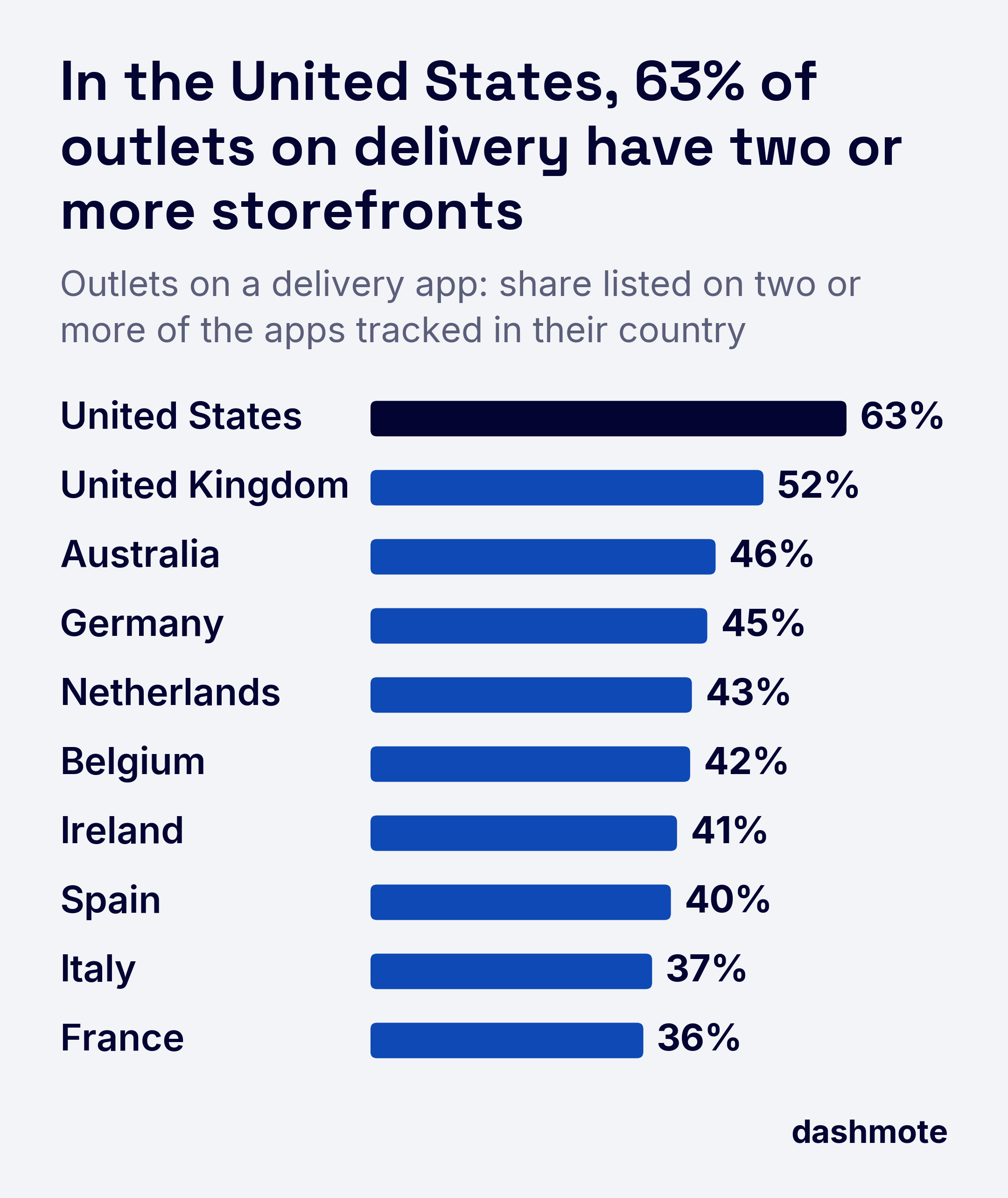
A delivery storefront is one outlet's listing on one delivery app: its page with name, menu, prices, images, opening hours, ratings and fees; Dashmote tracked 15M+ storefronts. A restaurant listed on three apps is one outlet and three storefronts, which is why every delivery KPI should say which of the two it counts, and why a store-by-store view shows who lists you and who lists a competitor.

The trusted intelligence layer for teams selling to Hospitality & Retail








What a storefront shows
The storefront is the delivery shelf for that outlet on that app. Everything a brand team measures on delivery is read from it.
- Identity: name, cuisine, address or delivery area, and the app it sits on
- Menu: sections, items, descriptions, images, pack sizes and combos
- Prices: item prices, and the fees and minimum order the app shows
- Status: opening hours, item availability, whether it is open for orders at the time of the check
- Demand signals: rating, review count and badges the app displays
How to count storefronts
Storefronts = sum over outlets of the number of apps each outlet is listed on
Usage varies on three edge cases, so decide them up front. A virtual brand (a delivery-only menu cooked in another restaurant's kitchen) has its own storefront but no outlet of its own. A chain lists one storefront per location, not one per chain. A shop on a grocery or quick commerce app is a storefront too, even though it sells packs, not meals.
For outlet-level reporting, link each storefront back to its physical outlet and count the outlet once.
Worked example
Take one city and one soft drink brand.
- 1,000 outlets in the city are listed on at least one delivery app: 400 on one app, 400 on two, 200 on three.
- Storefronts = 400 + (400 x 2) + (200 x 3) = 400 + 800 + 600 = 1,800.
- The brand is listed on 900 storefronts: 900 / 1,800 = 50% of storefronts. Those storefronts belong to 600 outlets: 600 / 1,000 = 60% of outlets.
Both numbers are right. The first says how much of the delivery shelf carries the brand; the second how many restaurants sell it on at least one app. The 10-point difference is outlets that list the brand on one app and not on another, a short and easy list.
Storefront, outlet or store?
An outlet is the physical place. A storefront is its page on one app. A store in quick commerce is usually a dark store or shop whose range is set by the app. A restaurant's own ordering app is not a storefront in this sense but a first-party ordering channel.
How Dashmote data helps
Dashmote reads every tracked storefront per app and refresh, and links storefronts to their outlet where the two can be paired, so teams report either unit without double counting. See listing and availability tracking and food delivery insights.
Frequently asked questions
What is the difference between a storefront and a restaurant?
A restaurant is the physical outlet; a storefront is its listing on one delivery app. One restaurant can have several storefronts, one per app.
Why count storefronts instead of outlets?
Because the shopper meets your product on a storefront, and each app's menu can differ. Count outlets when the question is how many restaurants sell you; count storefronts when it is how much of the delivery shelf you hold.
Is a virtual brand a storefront?
Yes. A virtual brand has its own storefront and menu, but it is cooked in another outlet's kitchen, so it adds a storefront without adding an outlet.
Do grocery shops on delivery apps count as storefronts?
Yes. A supermarket or convenience store on a delivery app has a storefront like a restaurant, with an assortment instead of a menu.
Does a storefront show sales?
No. Apps do not publish orders or sales per storefront. Ratings and review counts are the closest public signals of demand.